
Cold chain for small-scale fishers
Nelavo is a planned cooling service for fishers on Pulau Langkai. Reusable cold packs, charged at solar hubs, replace block ice, so fishers no longer borrow for ice and can sell fish with a temperature record. Hub construction starts in early 2027.
The problem: a cold-chain debt loop
Tap or click each step to see how it feeds the next, and where Nelavo steps in.
Fisher borrows for ice
Without cooling on the island, fishers buy block ice before each trip, often on credit from a collector.
Where Nelavo steps in: Charged cold packs are free to fishers who sell their catch to the hub.
How Nelavo works
Reusable cold packs replace block ice. The same box and packs stay with the fish from the boat to the buyer. This is the planned service: the pilot starts with hub construction in early 2027.
Collect charged packs
Fish at sea
Land and sell at the hub
Same box to the buyer
Return and recharge
Before a trip, fishers collect frozen PCM (phase-change material) packs from the hub and pack them into an insulated box.
Fish goes straight into the cold box on board. No ice to buy, no meltwater, no loan.
At landing, fishers sell eligible fish to us at a premium grade. A logger has recorded its temperature since the boat.
The box and packs stay with the fish by boat to Makassar and on by road, so packs never need to be swapped.
Used packs go back to the hub, where solar power recharges them for the next trip.
Packs are fully charged. The box starts cold before any fish goes in.
Fish is chilled within minutes of catch, which protects its grade.
The temperature record is proof of quality for the buyer.
No diesel refrigerated truck needed for the inland route.
The hub stores spare solar energy as cold in the packs.
Block ice or cold packs
Cold-pack figure: tests by a Japanese partner in SAKIGAKE JAPAN’s network (unpublished). ITB is validating it under tropical conditions. Ice and debt rows: our 2026 field study on Langkai.
What we build: solar, cold storage and a PCM thermal battery
Nelavo is more than cold packs. These four parts work as one system in every hub.
-
Off-grid solar panels
Power from the sun, with no grid connection.
-
Cold storage
Stores fish and freezes the PCM packs next to the landing.
-
PCM thermal battery
Daytime solar power is stored as cold inside the PCM, then carried to the boats as cold packs.
-
A smaller electric battery
Because the cold is already stored in the PCM, the battery is only a backup and can be smaller.
Planned for the Langkai and Makassar hubs. ITB is sizing the panel area and battery capacity for the lowest cost.
Price explorer: island versus city
What a Langkai fisher is paid, against what the first buyer pays for the same fish in Makassar. Choose a species.
Octopus (gurita) · per kg
Rupiah. Source: fisher interviews on Pulau Langkai and in Makassar, PT Inovasi Tangguh Bencana field study, 2026. Prices change with season and grade.
Squid (cumi-cumi) · per kg
Rupiah. Source: fisher interviews on Pulau Langkai and in Makassar, PT Inovasi Tangguh Bencana field study, 2026. Prices change with season and grade.
Cuttlefish (sotong) · per kg
Rupiah. Source: fisher interviews on Pulau Langkai and in Makassar, PT Inovasi Tangguh Bencana field study, 2026. Prices change with season and grade.
Coral trout (sunu) · per kg, not live
Rupiah. Source: fisher interviews on Pulau Langkai and in Makassar, PT Inovasi Tangguh Bencana field study, 2026. Prices change with season and grade.
Reef grouper (kerapu) · per kg
Rupiah. Source: fisher interviews on Pulau Langkai and in Makassar, PT Inovasi Tangguh Bencana field study, 2026. Prices change with season and grade.
Red snapper (kakap) · per kg
Rupiah. Source: fisher interviews on Pulau Langkai and in Makassar, PT Inovasi Tangguh Bencana field study, 2026. Prices change with season and grade.
Spanish mackerel (tenggiri) · per kg
Rupiah. Source: fisher interviews on Pulau Langkai and in Makassar, PT Inovasi Tangguh Bencana field study, 2026. Prices change with season and grade.
Rabbitfish (baronang) · per piece
Rupiah. Source: fisher interviews on Pulau Langkai and in Makassar, PT Inovasi Tangguh Bencana field study, 2026. Prices change with season and grade.
Flying fish (terbang) · per box
Rupiah. Source: fisher interviews on Pulau Langkai and in Makassar, PT Inovasi Tangguh Bencana field study, 2026. Prices change with season and grade.
Langkai in numbers
From the 2026 field study and the area's fisheries records.
From Langkai: field photos
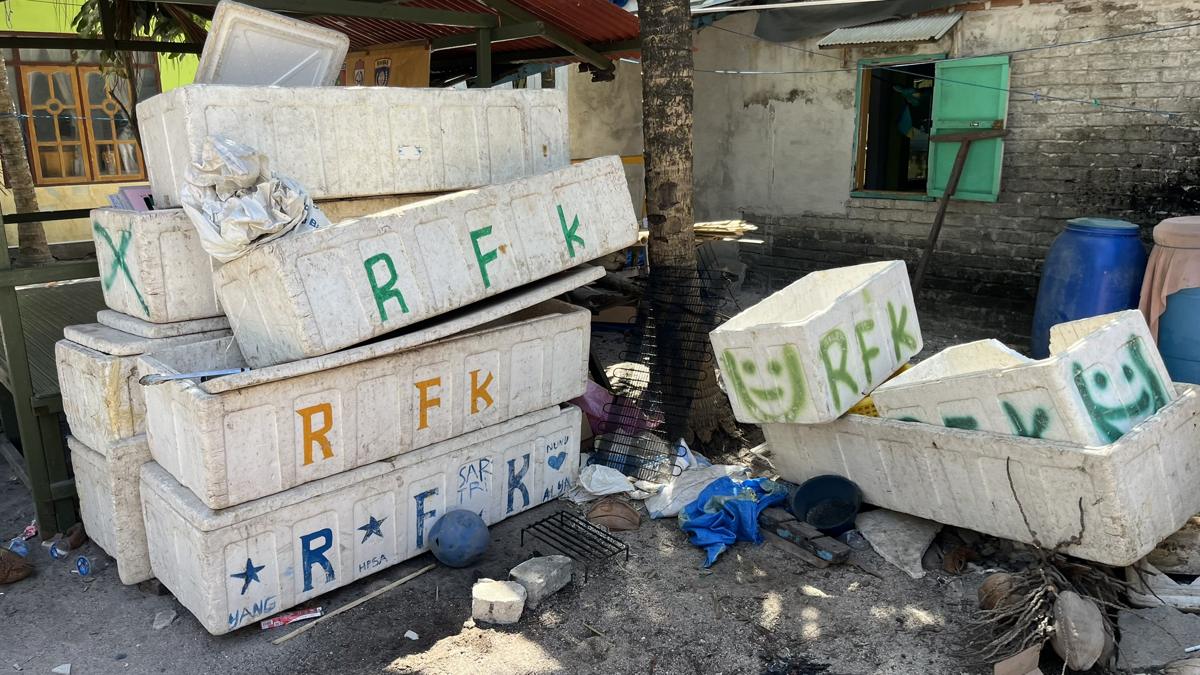
From the boat to the city: our 2026 visits to Pulau Langkai and Makassar. Click a photo to enlarge.
The plan: 17 months, five phases
All of this is planned. The field study is done; hub construction is planned for early 2027, and the exact start date depends on funding.
- Field study Langkai and Makassar, 2026 Done · we are here
- 1 · Inception and preparation Months 1–4
- 2 · Hub set-up and training Months 3–7
- 3 · Field operation and market testing Months 7–13
- 4 · Inclusion and expansion Months 7–15
- 5 · Evaluation and replication Months 14–17
Who is behind Nelavo
Who does what in the pilot.
Bandung-based company that brings proven Japanese and university technology into practical use. Will run the hubs and buy and sell the fish.
Japanese company working on decarbonization and cold-chain projects for Indonesian fishing communities. PCM cold packs and buyers in Japan.
Faculty of Mechanical and Aerospace Engineering. Tests the packs in tropical conditions and sizes the solar hubs.
Faculty of Marine Science and Fisheries, Makassar. Fisher surveys, freshness criteria and training.
Talk to the team
Questions about the pilot, buying fish, or working with us? Write or message us.
Fishers on Langkai: cold packs will be free for fishers who sell to the hub, with no new debt. Ask us on WhatsApp.
WhatsApp · 0813-2090-718 nelavo.id@gmail.com